The digital landscape is undergoing a significant transformation. If you’ve spent the last decade mastering the art of ranking in the “Blue Links” you’ve likely noticed a massive change in how users interact with search. Today, when someone asks a complex question Google doesn’t just give them a list of websites it gives them an AI Overview.
This is the era of GEO (Generative Engine Optimization). It’s no longer enough to be on page one; you need to be inside the AI’s brain. But how do you convince a Large Language Model (LLM) that your content is the most reliable source to summarize?
After testing various strategies across several e-commerce and service brands, I’ve identified five human-centric tactics that actually move the needle.
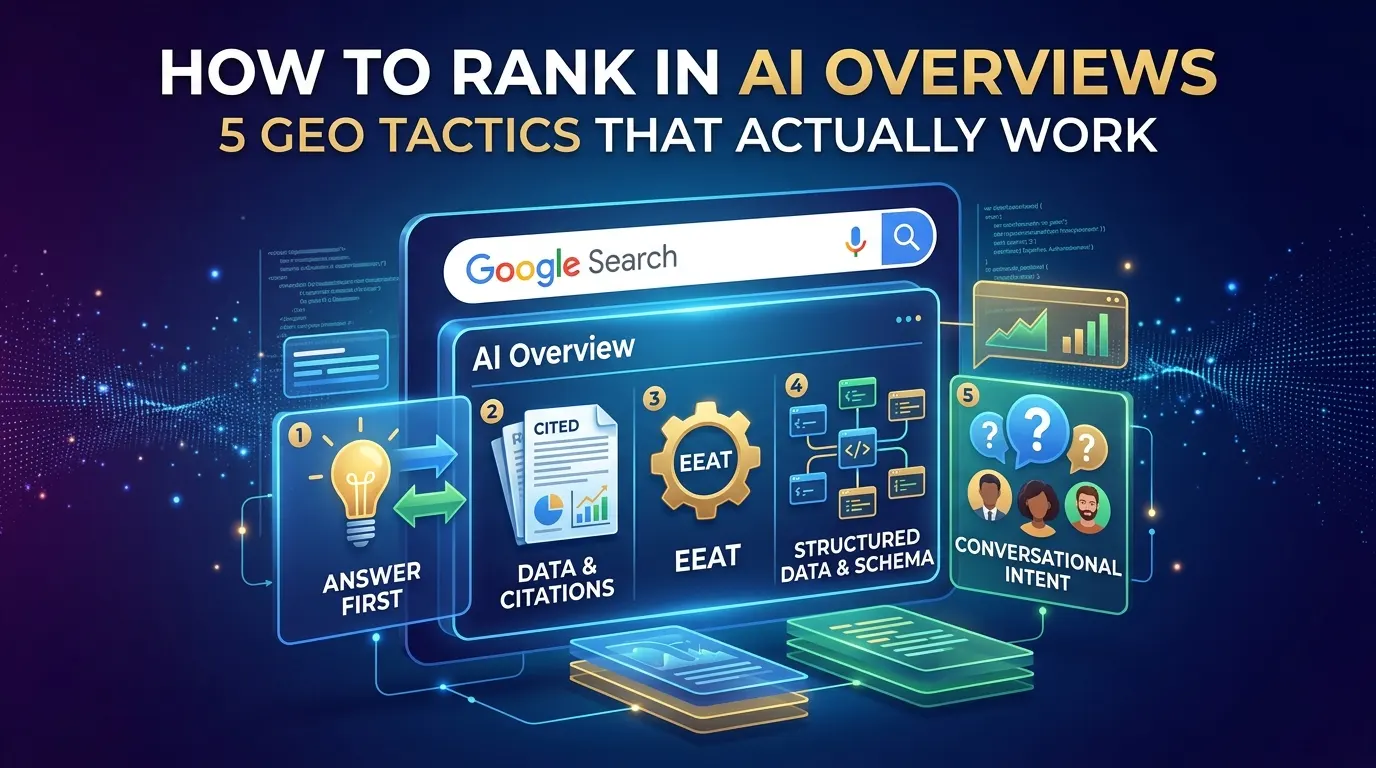
1. The “Answer First” Content Architecture
AI engines are inherently impatient. Their primary goal is to save the user from clicking through ten different tabs. If your blog post hides the “meat” of the answer under 500 words of introductory fluff the AI will simply skip you.
The Tactic: Adopt the “Inverted Pyramid” style of journalism. Start your sections with a concise, 2-3 sentence direct answer to the primary question.
- Why it works: AI models like Gemini and GPT-4 scan for “high-density information.” By providing a clear definition or solution immediately following an H2 heading you make it incredibly easy for the AI to “clip” your content into the summary box.
2. Leverage High-Authority Citations and Hard Data
AI models are programmed to avoid “hallucinations” making things up. To mitigate risk, these engines prioritize content that backs up claims with verifiable data. In 2026, a “trust signal” is worth more than a thousand keywords.
The Tactic: Don’t just say SEO Service in Pakistan is changing.” Say, “According to recent industry data, 65% of searches now result in zero clicks due to AI summaries.” Linking to original research, whitepapers, or government stats acts as a safety net for the AI. When an engine sees that your content is a hub of factual evidence it views your site as a low-risk high-reward source to cite in an Overview.
3. The “E” in E-E-A-T: Double Down on Experience
The one thing AI cannot do is live a human life. It can aggregate data, but it cannot share the “feeling” of running a business or the specific “nuance” of a technical fix. Google’s latest updates have made it clear: Experience is the ultimate differentiator.
The Tactic: Write in the first person. Share “boots-on-the-ground” stories. Instead of writing a generic guide on SEO, write about “The time we implemented Schema on a Fintech site and saw a 30% jump in impressions within 48 hours.” Unique images personal case studies, and “I tried this” narratives are gold mines for GEO. AI engines look for these unique perspectives to add “flavor” and “authority” to their generated answers.
4. Beyond Basic Schema: Narrative Metadata
Technically, AI needs a map to navigate your site. Standard SEO relies on basic tags, but GEO thrives on Structured Data. Think of Schema Markup as a translator that speaks the AI’s native language.
The Tactic: Go beyond the standard “Article” schema. Implement FAQ Schema, How-To Schema, and Dataset Schema. More importantly, ensure your content has a logical “Narrative Flow.” Use H2 and H3 tags that are phrased as questions. When your technical structure matches the way people naturally ask questions the AI can map your content to the user’s intent with surgical precision.
5. Optimizing for “Conversational Intent”
Keywords are becoming secondary to “User Intent.” In the past someone might search for “best running shoes.” Now they ask “What are the best running shoes for someone with flat feet training for a marathon in a rainy climate?”
The Tactic:
Optimize for the long-tail conversation. Stop obsessing over high-volume, short-tail keywords. Instead, look at the “People Also Ask” section of Google and build your content around solving those specific multi-layered problems. When you write for a specific person with a specific problem you become the “Direct Hit” for an AI search. Generative engines aren’t looking for the most popular page they are looking for the most relevant page.
The Human Verdict
The transition from SEO to GEO can feel overwhelming, but the core principle remains the same: Be the most helpful person in the room. AI Overviews are not detrimental to traffic; rather, they represent a new opportunity for establishing brand authority. By combining technical precision (Schema and Data) with raw human experience (Case studies and Direct answers), you position your brand as the definitive voice in your niche.
The future of search isn’t just about being found—it’s about being chosen by the machines that help humans decide.
Are you ready to optimize for the next generation of search? Let’s start by making your content more human.